
The Challenge
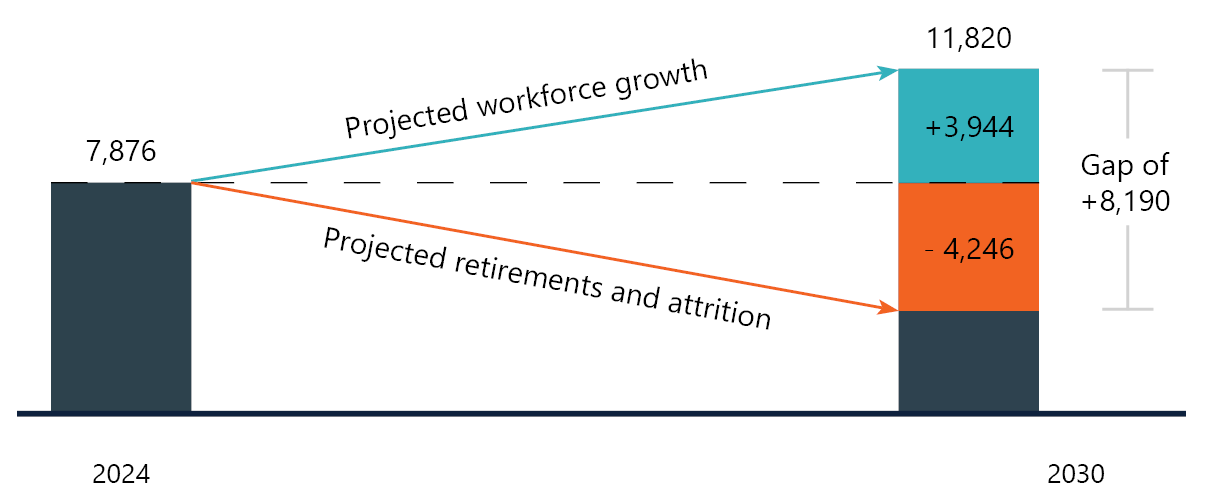
The Australian Public Service is facing a potential digital talent shortfall of more than 8,000 people in the next 5 years.
A continuing digital transformation agenda and the evolution of emerging technology is placing even greater demand for digital roles than previously seen. If continued annual growth of 7% is assumed (although predictions by the Australian Technology Council and Australian Computing Society predict a higher rate), the APS will have some work to do in attracting, building and developing the workforce required in the future.
With the added challenge of nearly 1 in 5 digital professionals expected to retire by 2030,1 the APS will likely to need to fill more than 8,000 additional digital roles in the next five years.2
Additionally, the Future Skills Organisation is predicting a shortfall of more than 61,000 digital roles nationally by 2030.3 The APS won’t be able to rely on the market to secure its digital workforce requirements for the digital future.
Much of this uplift may be found through redistribution of the existing APS workforce, particularly as emerging technology changes the nature of work. It is not anticipated that this increase in numbers would increase overall APS ASL, but rather leverage the changing face of the workforce. The approach to digital capability will need to change going forward. What got us to this stage will not get us where we need to go. A clear and structured understanding of workforce needs will be critical to success.
The APS must double its digital workforce by 2030 - Adding 1 new digital worker for every 1 currently employed.
-
Figure 1: Data table
Emerging Priorities
Australian Public Service Commission, APS Employment Database custom request RFI 2086, June 2024
Department of Education, Awards Course Completion Pivot Table 2023; NCVER, Total VET students and courses, 2023
Future Skills Organisation, Workforce Plan 2025: Pathways to Impact, 2025